29 September, 2005

-image-Korean Golf Secrets Exposed

Korean female golfers continue to excel in the Lady’s Professional Golf Association (LPGA). In fact out of the top 30 female professional golfers, 10 of them are Korean. You may be asking yourself, how is a small country like Korea able to dominate women’s professional golfing? What is the secret to their success? Is there some kind of advanced training regimine or some mystic Korean herbal tea that is giving them such an advantage? Well look no further, the Korea Times has leaked the ancient Korean secret to becoming a master golfer; the ability to use chopsticks:

What enables South Korean lady golfers to be so formidable in the U.S. LPGA Tour? It is nothing less than the Koreans’ talent to make things skillfully with their hands, a trait handed down from generation to generation for thousands years.  Celadon in Koryo and the Yi dynasty are world famous for blue and white china in quality, and you know that pottery involves the same skills as playing golf.

Not to change the subject, South Koreans’ special talent to make things skillfully with their hands is also believed to greatly contribute to their making almost a clean sweep of the World Skills Competition.  By the same token, Koreans are good at various sports that are played chiefly with the hands: handball, archery and table tennis, to name a few.

Professor Hwang Woo-suk of the Seoul National University who led the first cloning of embryonic human stem cells told in a public lecture that one of his assistants surprised the stem cell big shots of the world with his skills, which were beyond their imagination but actually nothing for Koreans. Professor Hwang, referring to the use of chopsticks, mentioned that the Koreans’ skill with their hands contributed to their success in cloning embryonic human stem cells.

An editor golf fan of an English daily newspaper mentioned that one of the root causes for Korean ladies to play such great golf in the U.S. is closely connected to dexterity, which is also critical to preparing delicious Kimchi, a Korean side dish loved by the people around the world.

That is right folks, chopsticks! With the ability to use chopsticks you can become a top professional golfer, make pottery, play handball, become a master archer, and if you still got some time left you can do a little embryonic stem cell cloning on the side. This is not to metion the fact you can be a skilled maker of kimchi.

I just love how the Korea Times had to make sure they put something in this article about how kimchi is loved by people around the world, though I have hardly seen kimchi outside of Korea when I have traveled around the world.

Something else to consider before you start praticing your chopstick skills, don’t practice using them like the Chinese or Japanese, follow only the Korean technique for using chopsticks and food preperation:

Japanese, who also use chopsticks like Koreans, once produced a golf great named Ayako Okamoto, who became a member of the LPGA Tour in 1981 and won 17 events between 1982 and 1992. She was recorded as the first woman from outside the U.S. to top the LPGA tour’s money list in 1987. Among Japanese golfers playing in the PGA of America is Shigeki Maruyama, who is often compared to South Korean golfer Kyung-ju Choi. Despite this, the Japanese do not surpass Koreans in the golf world possibly because they do not attach as much importance to the hands in preparing foods. They use sashimi knife in preparing raw fish, their all-time favorite, instead of directly using hands as Koreans do.

Similarly, the Chinese do not distinguish themselves as much as Koreans in the LPGA tour of America because they do not stress the role of hands in making foods. Their food culture features fire. Mostly they use fire to create taste instead of using their hands.  Among Chinese golfers, Hong Mei Yang became the first Chinese player to win a tournament in the United States in April 2004 by capturing the IOS Futures Golf Classic in El Paso, Texas, the developmental circuit for the LPGA Tour.

Of course, there are some other factors that make all the great achievements possible including tenacity and indomitability, two characteristics of Koreans, along with quite a lot of synergy among the South Korean golfers. But without the dexterity unique to Koreans their great success would be hard to imagine.

For those not familiar with the Korean media, these type of articles are very common to reinforce Korean pride and sense of superiority, especially over the Japanese and the Chinese. Everything seems to revolve around kimchi, chopsticks, and Dokto.  My only question is how did Annika Sorenstam become so dominant without kimchi, chopsticks, and Dokto?

If you haven’t had enough chopsticks and kimchi you can read more about it over at Cathartidae.

by @ 3:07 am. Filed under Asia, East Asia, South Korea

27 September, 2005

-image-Hollywood Losing Influence in Japan

Bae Well known Hollywood stars have a secret they don’t want you to know about:

A Hollywood in-house secret, Japanese TV commercials were once talked about with a wink and a shake of the head. Piles of cash were paid to stars willing to peddle anything from whiskey to cigarettes, cars to coffee, instant noodles to cafe latte — as long as nobody told the fans back home. Hey, did you know Dennis Hopper did one for bath products? How much do you figure Leonardo DiCaprio got for that SUV spot? A million? Three?

However, these Hollywood stars are losing their popularity in Japan:

Sadly, the days of seeing, say, Harrison Ford guzzling Kirin beer may be over. American stars have not vanished from the Japanese advertising landscape, but their numbers have dropped dramatically since the heyday of the 1990s, when even Mickey Rourke was considered bankable here.

So who is taking the business from these Hollywood stars? Asian film stars are, led by the remarkable success of Korean film star Bae Yong-joon or otherwise known in Japan as Yon-soma:

“The Hollywood brand isn’t the best anymore, and Hollywood actors aren’t effective enough anymore,” said Yukio Mori, president of Systrat Corp., a marketing and promotion consultancy in Tokyo. “Consumers are in favor of singers or artists who are familiar, rather than foreign movie stars.”

The catalyst for the change, almost everyone agrees, has been Japan’s raging love affair with Korean culture that took everyone here by surprise two years ago.

The phenomenon was spearheaded by a drama series called “Winter Sonata,” a tragic love story featuring Bae Yong Joon, a South Korean actor affectionately referred to as Yon-sama in Japan. With his baby face and great teeth, Yon-sama, 33, flutters the hearts of Japanese women in their 30s and older, who tell market researchers he rekindles the romantic urges they felt in their youth.

It’s a demographic that makes marketers swoon, too. Yon-sama is now the biggest foreign star in Japan. Bigger than Brad. Bigger than Leo. Dozens of Japanese companies are desperate to attach their brand to Yon-sama, or at least to find the next great Korean star.

I don’t much care for Hollywood stars any more either, so I can’t blame the Japanese public getting turned off by them. Today’s Hollywood actors seem more concerned about promoting themselves and their politics than actually making good movies.  Anyone see Sean Penn show up in a boat in New Orleans with his personal photographer? 

Chinese film stars as well are having success advertising products in Japan including one of my personal favorites Zhang Ziyi:

And Asiance, a shampoo brand built on defining beauty with a pan-Asian look, has seen its market share grow after an ad campaign featuring China’s Zhang Ziyi, who starred in “Crouching Tiger, Hidden Dragon.”

If I was trapped in New Orleans I would rather have Zhang Ziyi come to save me instead of Sean Penn.

by @ 7:45 pm. Filed under Asia, China, Culture, East Asia, Japan, Media, Northeast Asia, South Korea

-image-sex ed in seoul

Sexmusuem In a country filled with a thriving sex industry it comes as no surprise that Seoul now has it’s very own Erotic Art Museum:

Nestled behind the Hyundai Department Store next to Sinchon subway station, the Erotic Art Museum would be easy to miss save for a shiny golden replica of Michelangelo’s David outside that evokes both the elegance of some exhibits and the tawdriness of others.

The museum’s gregarious director, Won Myung-ku, did not stumble onto this calling by chance. A former worker in the tourist industry, he was blessed with the opportunity to do extensive traveling, during which time he came across and collected traditional craftworks dealing with sex from as far as Malaysia, Thailand and Africa. These experiences brought home to him how few such artifacts he had seen from his homeland.

“A culture of sex has been lacking in this country,’’ he said, “and I want to contribute to increasing the level of sex education among Koreans.’’

It is ironic that Mr. Won thinks Korea lacks a culture of sex when you are literally surrounded by the sex industry here. Just about every US military installation has clubs that offer prostitution right outside the main gates. Than there are multiple red light districts in every city here.  I have even been on the remote Korean island of Ullong-do and I was amazed to see a red light district on the island as well.  In addition to the clubs there are “barber shops”, massage parlors, and tea shops that offer their own sex services. 

The museum does offer some interesting historical perspectives on Korean customs towards sex during earlier Korean dynasties:

Elsewhere, there is a wide array of phalluses, used for everything from preventing disease to promoting fertility to fighting infidelity. Apparently, in Choson times it was believed that if women in the village were committing adultery, it was a sure-fire sign of too much “umgi,’’ the feminine form of “ki,’’ or the “life-force’’ which is central to much Eastern philosophy and medicine. The placement of a large wooden phallus in the village was considered the best way to deal with this problem.

They may need to put theses phalluses on every street corner in Korea now a days. 

by @ 6:53 pm. Filed under Asia, Culture, East Asia, Northeast Asia, South Korea

25 September, 2005

-image-light posting

Due to the relocation of the AsiaPundit global headquarters, a delay in the new HQ’s internet setup, plus a mid-week trip to Nanjing, there will be a very light posting schedule over the next week. I encourage readers to check out Simon World and Global Voices Online in the interim (but do come back).

Also, I’ve recently added a tip-jar and advertising. Our first paid ad is from Kangtao.com, a Singapore community classified site.

For more details on advertising (or contributing) contact Asiapundit@gmail.com.

by @ 2:15 pm. Filed under Uncategorized

24 September, 2005

-image-scrutinizing chinese state-run corporations

The Horse’s Mouth points to an article from NewsMax that highlights one of the reasons Washington might be justified in its concern over Chinese state-run companies purchasing American corporations:

The Chinese army has converted a U.S.-made airliner into an advanced military command aircraft. The conversion is a direct violation of U.S.-Sino trade agreements and U.S. export laws. Officials at the U.S. State and Commerce departments refused to comment on the illegal Chinese modification.

….The aircraft now serves the Chinese army and is intended to fly PLA commanders during war. The 737 is intended to allow a PLA crew of generals and staff to fly close to a battlefield, issuing commands to their army, navy and air force from the airborne headquarters.

If the Chinese are so willing to blatantly disregard international trade agreements in order to further their military influence, why should it be so surprising that Washington and the American public feel threatened by corporate takeovers by Chinese state-run companies? Particularly those that involve strategic energy resources such as oil and natural gas.

by @ 6:42 pm. Filed under Asia, China, Current Affairs

23 September, 2005

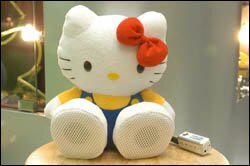
-image-hello kitty lawsuit

Still more evil from the mouthless one from Sanrio.:

The Standard reports on the long arm of Sanrio and its damn cat:

 Archives Kitty Hello Kitty’s copyright holders are threatening to sue FM Theater Power, a local drama troupe, for infringing its intellectual property rights, it was revealed Thursday.

The stage enthusiasts, a group of secondary students and drama lovers, said they received a letter Wednesday last week from local solicitor Victor Chu and Co representing Sanrio of Japan accusing them of stepping on Hello Kitty’s copyright tail.

Sanrio requested that the drama group disclose all the details of activities connected with the production, promotion and staging of the play Kitty Hunter, including advertising materials, ticketing information, audience counts, revenue and profit…Banky Yeung, artistic director of the group and writer of Kitty Hunter, said the drama was simply a love story about a girl named Kitty, even though plush Hello Kitty toys are used as props and images similar to the cartoon character serve as promotion materials…

The good news for the theatre troup is this kind of publicity will do far more for ticket sales than any flyer.

If you can stomach it, you can eat Hello Kitty.:

 Ramen Ramen

Stopevil-1

Technorati Tags: , ,

by @ 9:27 pm. Filed under Asia, Culture, East Asia, Hello Kitty watch, Hong Kong, Japan, Northeast Asia

-image-poll on format changes

AsiaPundit is considering discontinuing the almost-daily link roundups in favor of a series of short-posts. The key reason for this is because feedburner is unable to handle the larger more graphic-heavy posts that have been common here.

A question for regulars: would you prefer a less-graphic roundup or a short-post structure?

by @ 5:05 pm. Filed under Uncategorized

22 September, 2005

-image-thursday links

ESWN makes a good argument in defense of Yahoo!’s co-operation with Chinese state security, and says he expects stone silence to his post. Because of that, it gets top of the page in today’s roundup.:

Yahoo2The police came quickly, assessed the situation
and decided that there was a chance of a bomb.  Hong Kong is one place that
takes possible explosives very seriously on account of the 1967
disturbances.  All pedestrian and vehicular traffic along Nathan Road was
stopped, and all shoppers and workers were evacuated.  This led to massive
traffic backups in one of the busiest part of the city.  At around 930pm, the
explosive disposal squad was in place to defuse the bomb.  A robot was sent
up and used a water gun to break open the box.  Fortunately, there was no
bomb inside, just two bricks.
The investigators then looked at the piece of
cardboard.  It read like a note from a disgruntled ex-employee of
PCCW.  There was an email address: csl_no_pay_cash@yahoo.com.hk.
Based on this and other information (note: there was a web page URL that is
blurred out in the magazine photo), the man was arrested.  He has been
tried and found guilty of threatening behavior.  The judge said: "In
the 21st century of our times, there are numerious incidents of violence,
attacks and bombing in the world.  To make the people of Hong Kong live in
a state of constant fear is a serious crime."  The man has not yet
been sentenced. . .
Yahoo1If several hundred requests come into Yahoo!
every day, how would they know which is which?  As Jerry Yang said,
"We do not know why they want that information.  We’re not told what
they look for."  So in order to tell which is which, Yahoo! will have
an in-house Chief Privacy Officer, who will demand the law enforcement agency to
produce the full evidence, explain the purpose of the inquiry and then he/she
will play God/Supreme Court Justice and render a decision in his/her infinite
wisdom.  Routinely, this CPO will have to make several hundred potentially
life-and-death decisions every day.  Now who wants that Chief Privacy
Officer job, with all the pressures and the legal and moral liabilities?. . .
In the case of Shi Tao, the law enforcement
will simply say the subject is suspected of having sent a state secret document
overseas via the Yahoo! email account on a specific date.  There is no
personal identification because the purpose of the request for the IP
information was precisely to detect the unknown subject.  Would you think
that the CPO will then demand to read the state secret document before deciding?
Is the CPO a good judge?  And does the CPO know how to deal with a genuine
national secret (such as the date and detailed plans of the invasion of Taiwan)?
I submit to you that Option 3 is not a good idea and corporate employees should
not be making these types of decisions.
As I said before, I expect stone silence to
this post, because the world is enjoying Yahoo!-bashing too much.

We now return to our regularly scheduled Yahoo! bashing.

Essential reading for cyber-dissidents, Reporters Without Borders has issued its guide for bloggers (pdf). Rebecca reviews it here.:

BlogguideThe Handbook for Bloggers is useful for beginners and veteran
bloggers alike. It starts out with several introductory chapters,
explaining how blogs differ from other kinds of websites, blogging
terminology, how to select a blogging tool and web-host, and how to get
started.  The middle chapters focus on tips that even veteran bloggers
will find useful. Journalist, blogger and We the Media author Dan GillmorMark Glaser
offers tips on how to "make your blog shine." I learned a lot from the
chapter on how to get your blog picked up by search engines, written by
internet consultant Olivier Andrieu.

A while back, I posted an Atanu Dey item praising Singapore over India. Today, via Amit Varma, an item that argues Singapore’s northern neighbor also has some lessons for India.:

MalaysiaMy wife and I are in Malaysia now on a short term assignment for our
company, and every time we step out of our house in Penang, we feel the
amazing effects of a liberal economic policy. This small, densely
populated island off the coast of Malaysia (Penang) is a big
electronics manufacturing base (thanks to a Free Trade Zone, and a port
that was formerly duty free) and it is easy to see what this has done
to the local economy.
There is a booming free-spending middle
class, and almost no poverty. Everyone who wants to work seems to be
able to find a job, and they are doing well enough to import labor from
Indonesia for low-paying jobs. There are signs of development
everywhere - new roads, new bridges, new high-rises. And from what I’ve
heard, Penang reflects what is going on around the rest of the country.
IndiaNot
to say Malaysia doesn’t have its problems, but economically, they seem
to have found the secret to growth. We see all this, and naturally, the
next thing we think is, "When will this happen to India?"
We are
doing it backwards, it seems - Malaysia had manufacturing move over
here first, and that brought in a support engineering force which
slowly grew into a full fledged "high-tech economy." We got some
"low-tech" engineering activities first, and are hoping for the trickle
down from this to help our economy in other areas.

Far Outliers links to a study on the divergence of opinions in China and Canada on separatism.:

TaiwanWhereas Canada has acclimatised to living next to its superpower
neighbour, absorbed the values of a virtual state and discarded the
traditional expectations of the importance of territory, China is a
rising power with an acute sense of grievance from the way it has been
treated historically, or at least the way it perceives it has been
treated. This strong inferiority complex has stimulated an intense
desire to do something about what many Chinese believe is their
misfortune, to occupy an international position that conforms to
traditional power politics and emphasises the value of territory.
QuebecCanada’s attitude is reinforced by its commitment to democracy and
interdependence, and to the granting of the wishes of the people of
Quebec, whatever they may be. The Chinese, on the contrary, lacking
both a commitment to democracy and self-determination or the status of
a developed state, view Taiwan not as an area containing a population
that should have some say in how they are governed, but as a
geopolitical object to be manipulated to maximise the glories of a
greater China.

Richard brings a troubling tale from the NY Times on police brutality and injustice in China.:

For three days and three nights, the police wrenched Qin Yanhong’s arms
high above his back, jammed his knees into a sharp metal frame, and
kicked his gut whenever he fell asleep. The pain was so intense that he
watched sweat pour off his face and form puddles on the floor.
On the fourth day, he broke down. "What color were her pants?" they
demanded. "Black," he gasped, and felt a whack on the back of his head.
"Red," he cried, and got another punch. "Blue," he ventured. The
beating stopped.
This is how Mr. Qin, a 35-year-old steel mill worker in Henan
Province in central China, recalled groping in the darkness of a
interrogation room to deduce the "correct" details of a rape and
murder, end his torture and give the police the confession they
required to close a nettlesome case.
On the strength of his coerced confession alone, prosecutors
indicted Mr. Qin. A panel of judges then convicted him and sentenced
him to death. He is alive today only because of a rare twist
of fate that proved his innocence and forced the authorities to let him
go, though not before a final push to have him executed anyway
.

In light of the bird flu scare in neighboring Indonesia (which authorities there are calling an epidemic) Malaysia is cracking down on chicken smugglers (surely there are more lucrative illegal trades).:

ChickenI mean real chickens, the ones we have on our table for dinner. Yes,
it seems Malaysia actually has a shortage of chickens, hence a window
of opportunity opens itself for more dubious characters to actually
make a living smuggling them from neighbouring countries.
Now I know why a friend of mine who was an accountant quit his job
to open a chicken farm. The ‘rumour’ that McDonalds Malaysia created
quite a few ‘chicken’ millionaires might be true then.
From a Reuters report,

Malaysia said on Wednesday it was boosting precautions
against bird flu, and considering fines or jail terms for smugglers of
poultry from neighbours such as Indonesia, now battling the disease.

Seven-years to the day following his jailing, as Lone notes, former Malaysian PM Anwar Ibrahim announced he plans to sue former Prime Minister Mahathir Mohamad for defamation.:

AnwarMahathirFormer Malaysian deputy premier Anwar Ibrahim said Tuesday he will
launch a lawsuit against one-time prime minister Mahathir Mohamad for
accusing him of being a homosexual.
Mahathir said earlier this
month that he was forced to sack Anwar in 1998 to prevent mainly-Muslim
Malaysia from having a homosexual leader. Anwar was jailed for sodomy
after his sacking but the conviction was overturned last year.
"I
cannot have a person who is like that in my cabinet who may succeed and
become the prime minister. Imagine having a gay prime minister. Nobody
would be safe," Mahathir told reporters.
Anwar said he was
"shocked" to hear of Mahathir’s "defamatory" remarks, particularly
after a court last month awarded him 1.2 million dollars in damages
over a book that aired the sodomy allegations.
"I will not
allow this lie and slander to continue. Thus I have instructed my
counsel to initiative legal action against Tun (honorific) Mahathir,"
he said in a statement.

Lucia Lai notes that some concerns are being voiced over Dr M being allowed to participate in a human rights conference.:

The Human Rights Commission of Malaysia (Suhakam) marked its 6th
anniversary and Human Rights Day in Malaysia recently by holding a
hypocrisy party in the capital city, with former premier Dr Mahathir
Mohamad giving the opening address.
A group of 30
non-governmental organisations (NGOs) had initially written an open
letter to Suhakam urging it to "close the door" on Dr M for a simple
reason that he had committed a host of "human wrongs" with regard to
human rights at home.
They had provided Suhakam a list of human
rights abuses in Bolehland by Dr M and pointed out that it would be
wrong to invite "a leader who perpetrated extensive human rights
violations" during his 22-year political reign."

AsiaPundit has earlier noted South Korean concerns about how Google Earth allows users to view the South Korean presidential compound and military bases, Pyong’yang, and the secretive Communist Party of China compound of Zhongnanhai. Politics 101 Malaysia is now noting that the spy satellite for the masses is causing concern in Kuala Lumpur.:
       

After recent my recent comments on Google Earth here and here,  the fear continues.
A United Press International report on
Tuesday says terrorists and “rogue state” intelligence agencies could
be making use of free internet satellite images that leave sensitive
British military facilities exposed.
Yet again I ask, will our parliament address this issue during this session?

Tokyo Times reports on the 2005 video game show, some of it’s good… but some of it is frightening.:

Booth_babeCosplay_freakAs far as video games go, the 2005 Tokyo Game Show
was something of a let down. Microsoft to its credit had the Xbox 360
up and running, yet the playable games on offer hardly sent the pulse
racing. Sony on the other hand managed to do nothing but frustrate,
showing only videos of future PlayStation 3 software, the majority of
which contained very little (if any) in-game footage.Thankfully
the ubiquitous booth babes saved the day, the scantily clad young
ladies more than making up for the lack of quality games on offer….
Yet amazingly, this bevy of beauties was upstaged by the event’s
massive cosplay contingent. ..
However despite the coy smiles and tasteful wigs, I think it was the
shapely legs and green leotard of the group’s feminine leader that
grabbed most people’s attention.

A Taiwanese in China creates a blog dedicated almost entirely to toilets (seriously).:

Toilet1This one is the same as last one. Toilet in tibet temple. These walls
are higher than those in 1st picture. So, you can not play cards with
your friends who go to toilet next to you. :)…
Toilet2This toilet is more "modern". This one was taken in
a famous tibet temple in yovnan. The small metal spot on the wall is
the button for you to clean your "waste".
Do
you know how to go? Yes, face out. No door, of course. But, in this
toilet, there is water. You can push the button on the wall. Yes, that
very small metal spot in the picture. So, in this kind of toilet, no
shit smell. It’s clearier. There is also another kind of toilet in the
very courtryside place. I did not take pictures. CAUSE, I CAN NOT GO
INTO THAT KIND OF TOILET. Shit everwhere near the door of that kind
toilet. How can I go? It’s really very strange. How do local people go?…
Usually,
this kind of very local & old toilet are in very small viliages.
"public toilet", mm, maybe. So, next time when you have a chance to
drive along a road in small countries in mainland China, remember to
find "public toilet". Then you can see this very localized toilet in
person.

Monty Python needs to reform and do a skit on Taiwan politics, like the WUFI, the People’s Front of Judea are also Splitters/Splittists.:

In case you were wondering the ‘World United Formosans for Independence’ and the ‘Taiwan Defence Alliance’ should not be confused with pro-formal independence political parties like the Taiwan Solidarity Union (which regularly polls between 5-10% in national elections), the ‘Taiwan Independence Party’ (which gained 0.3% of the vote in the last election), the ‘Peasant Party’ (0.4%) or the ‘Taiwan Number One Party’ (didn’t bother standing).

Someone will not be getting another invite to speak at Beijing University.:

Prominent Taiwanese commentator/legislator/raconteur Li Ao delivered one mother of a speech
at Beijing University yesterday. In front of a stunned audience, with
several high-ranking mainland government officials openly squirming on
stage, Li let her rip.
He openly criticized China’s censorship, saying that went against
what even Mao Zedong and Zhou Enlai would have wanted. Quoting the
Collected Writings of Mao Zedong, he said,
"凡是歷史上發生的東西,都要在歷史上消滅。因此,共產黨總有一天要消滅…,S’s" i.e. "Every
historical figure that has risen has also been destroyed. One day the
Chinese Communist Party will also be destroyed by history…our mission
is to bring about its destruction a little more quickly." He made
not-so-subtle references to the Tiananmen massacre, saying that all
governments are bastards who are willing to open fire on their own
people. He even got in plenty of digs against the
charismatically-challenged former KMT chairman Lian Zhan and the
charismatically-gifted but politcally-challenged current KMT chairman
Ma Yingjiu.

Mr Wang notes Jacob’s run in with the authorities because his number was saved on Singapore Rebel director Martyn See’s cellphone. Mr Wang says the Singapore police really should exercise some restraint, at least for PR reasons.

…please bear in mind that Martyn See is blogging about every stage of
your investigations. This is a highly sensitive case. All kinds of
media organisations, international and local, are closely following
Martyn See’s blog for updates. So Mr Wang advises you to take extra
care in how you conduct your investigations. If you do any silly things
like Haul Anyone and Everyone Who Is Found in Martyn See’s Handphone
Down to the Police Station For Interviews, Martyn will blog about it
and the whole world will read his blog and think the Singapore police
is really acting silly.

Japundit reminds us why Engrish.com should be a regular surf stop.:

Behind

by @ 10:59 pm. Filed under Asia, Blogs, Central Asia, China, Culture, East Asia, Hong Kong, India, Indonesia, Japan, Malaysia, Media, Northeast Asia, Singapore, South Asia, Southeast Asia, Taiwan, Weblogs

21 September, 2005

-image-short wednesday links

Monday’s big news - that North Korea was giving up its nuclear program - was, as I expected, a premature April Fool’s joke.:

Having agreed to relinquish all nuclear weaponry and programs less than a day ago, North Korea is already back to its extortionist routine (via The Lost Nomad):

North Korea said Tuesday it will return to an
international non-proliferation regime and allow inspections by the
U.N. nuclear watchdog only after receiving a light-water reactor from the United States…
The
statement went on to say that the U.S. should not dream that the North
will scrap its nuclear deterrent without provision of a light-water
reactor, a basis of mutual trust [boldface mine].

Since the US position has been crystal clear that the demand for a
light-water reactor is a "non-starter," one wonders exactly what was
achieved by the "breakthrough agreement" yesterday.

Do you Yahoo!? Well stop! They’re evil. Rebecca McKinnion does a test on China’s internet filters and discovers that Google is the lesser of two evils.

YahooWhat do these screenshots illustrate? They show that Yahoo! actively
filters politically sensitive terms from within its own service. Even
if a Chinese user finds a way to access Yahoo from outside China or via
a foreign proxy server, they will still get filtered search results on
politically sensitive terms. By contrast, Google does not actively
filter. The filtering of Google search results is done only by the
Chinese ISP… although Google helps hide this process from Chinese
users by choosing not to show results that the Chinese user would be
unable to access.

And after helping have a journalist jailed, Yahoo! has decided to build its own news team (IHT via Howard French).:

HONG KONG Journalists beware. Hot on the heels of news that Yahoo
provided the information that helped China’s state security apparatus
to track down and jail a reporter comes the same company’s announcement
that it is to hire a journalist to provide its own coverage of major
global events.
The first item is troubling enough. The Chinese reporter, Shi Tao, who
worked for a Chinese newspaper, was given 10 years in jail for
providing "state secrets to foreign entities" - the "secrets" being new
censorship impositions that he passed on to two overseas prodemocracy
groups.
The juxtaposition of the second is alarming. It is hard not to draw the
conclusion that Yahoo’s news gathering will be driven by the same
profits-at-all- cost mentality behind its cooperation with China’s
suppressors of news providers and whistle blowers.

For more on Yahoo!’s China activities visit the highly dedicated, English and Chinese, Yahoo Privacy Blog.

But to be fair to Yahoo!, no company would give up a chance on doing business in China because of ethical considerations…. What’s that? Time Warner quit China over censorship requests? Woah!

According to Chief Executive Officer Parsons, it was
AOL-Time Warner who pulled out of the partnership with Legend in 2001
after authorities in Beijing made a series of unreasonable demands on
the company in regards its joint Internet venture with Legend; leading
AOL-Time Warner executives to pull out of their partnership over
ethical concerns, and the fear that acquiescence to Beijing’s demands
would seriously damage the company’s standing with consumers in the US.

“[We were concerned about] what we would look like here in the U.S. if we agreed to a governmentally imposed regime where words like democracy had to be blocked”

Richard Parsons, Chief Executive, Time Warner

Top
among the reasons cited by Chief Executive Parson, as being behind the
ending of the partnership, was the insistence by Beijing that
Government agencies be allow to intercept, modify and retain data being
sent to and from the online subscribers; a move that would have enabled
Chinese security forces to eavesdrop on anybody in China who used AOL’s
software or servers to access the Internet, and to block any or all
content as they saw fit.

This doesn’t mean that AOL doesn’t suck, but merely that they suck less than Yahoo!.

Unlike China Doll, AsiaPundit thinks this is great branding.:

ClBEIJING (AFP) - A condom maker in southern China’s Guangdong province
is marketing its products under "Clinton" and "Lewinsky" brands and has
registered the names as trademarks, state press said.
The Guangzhou Haojian Bio-science Co is selling its wares under the
Chinese spelling of the names that read "Kelintun" and "Laiwensiji,"
the New Express reported.
ClintonlewinskiThe names in China are easily recognizable as former US president Bill Clinton and his one time lover, Monica Lewinsky.
The Clinton brand is set to be the company’s top product selling for
some 30 yuan (3.7 dollars) for a pack of 12, while the Lewinsky brand
was expected to fetch 18 yuan.
The company unveiled the product on Monday. General manager Liu Wenhua
expressed confidence the names would not get him into trouble since
they are only "trademarks of two foreign surnames and can’t be seen as
a violation of rights," the report said.

I visited Arms Control Wonk for details on Monday’s statement on North Korea’s nuclear program, and ACW does have great stuff on that, but also of interest was this creepy item.:

GeneThe advertisement (right) is not science fiction.
Blue Heron Biotechnology of Bothell, Washington “can synthesize any gene regardless of sequence, complexity, or size …”
Gene
synthesis is a revolutionary technology, which offers the prospect of
making life better for millions of people around the world. The ability
to order the exact gene would revolutionize the production of vaccines
and the creation of tiny bio-machines.
But what if you wanted to cook up some synthetic polio in the lab?
You can do that, too.
A group of researchers from SUNY Stoney Brook synthesized polio over the course of three years. Blue Heron claims it can perform a similar size job in a little under 12 weeks.
Terrified yet? In 2003, a CIA Report entitled The Darker Bioweapons Future warned that advances in biotechnology “could be used to create the world’s most frightening weapons.”
Blue Heron has refused orders that seem suspicious;for example, Blue Heron turned down
an order from Saudi Arabia for a variola gene related to smallpox—but
not all manufacturers of synthetic genetic material screen purchases.

Following in the footsteps of his father, Cambodian King Norodom Sihamoni has launched a website. We hope a blog will follow. (via Cambodia Morning):

The ruler will keep his subjects up to date on the new internet site.
The
website is divided into five sections - news, biography, social
activities, correspondence and video - and will be written in three
languages, English, Khmer and French.
Before launching the new web page, the king used the internet site run by his father, former King Norodom Sihanouk.

Is the Korea Wave over? In Korea, it’s hip to be Japanese.:

Today’s Yahoo messenger cultural lesson was in regards to the word "san" which I have always thought meant "mountain" in Korean.
But lately, I have noticed that Koreans are starting to address each other like this: Bae-san, Kim-san, Park-san, etc.
I asked Jeff what was up with that. Surely they weren’t referring to each other as Mount Bae, Kim Mountain or Park’s Peak.
All of it seemed very reminiscent to
me of The Karate Kid and (what was his name, the guy who caught flies
in his chopsticks…Mr. Yagi?) the whole "Daniel-san" thing.
Jeff then told me that the Koreans are using "san" these days not as in the word mountain, but as in the honorific title used in the Japanese language just like Yagi did in The Karate Kid with Daniel-san.

The day job and technical problems have restricted blogging in recent days. Part of that will soon be solved.

(more…)

by @ 11:56 pm. Filed under Uncategorized

-image-“juche ted”

Turner After reading this transcript of Ted Turner’s interview with Wolf Blitzer I am positive the guy is nuts.  Here are a few excerpts:

We have agreement there. But I had a great time. I am absolutely convinced that the North Koreans are absolutely sincere. There’s really no reason for them to cheat or do anything to violate this very forward agreement. I think we can put the North Korea and East Asia problems behind us,

(…)

Well, hey. Listen, I saw a lot of people over there. They were thin, and they were riding bicycles instead of driving in cars. But I didn’t see any brutality in the capitol, or out in the DMZ. We drove through the countryside quite a bit to down to P’annumjom and Kaesong. We traveled around.

I wonder what Ted Turner is thinking now that the North Koreans have already reneged on their agreement?  Plus has it ever crossed Ted’s mind that the people are thin over there not because they ride bikes, but because of the poor agricultural policies he mentioned in the interview?  Make sure you read the rest on your own.  Especially if you are from Alaska.  Turner doesn’t feel you are worth protecting from a North Korean missile attack.  You can read more this here and here.  I guess we can just call him “Juche Ted” for now on.

Technorati Tags: , , , ,

by @ 7:07 pm. Filed under Asia, East Asia, North Korea, Northeast Asia, South Korea

19 September, 2005

-image-breakthrough(?)

With Japan, Korean and Hong Kong down for holidays, I expected a slow news day. I also hadn’t expected April Fool’s Day stories on the start of Korea’s Chuseok, Japan’s Aged day holiday and Hong Kong’s mid-autumn festival. I was wrong.

This is unexpected! North Korean, perhaps, seemingly, have …

pledged to drop its nuclear weapons development program
and return to the nuclear non-proliferation treaty (NPT).
In a joint statement issued here Monday, North Korea promised to
give up all nuclear weapons and present nuclear programs and to return
to the NPT as soon as possible, while accepting inspections by the
International Atomic Energy Agency.

Kushibo, who doesn’t likely remember me from Kexpat, notes:

The North "committed to abandoning all nuclear
weapons and existing nuclear programs and returning at an early date"
to the Nuclear Nonproliferation Treaty and International Atomic Energy
Agency safeguards, according to the agreement.

In
exchange, the North would receive energy assistance and a pledge from
the United States that it won’t attack. Pyongyang and Washington
pledged in the agreement to respect each other’s sovereignty and right
to peaceful coexistence, and also to take steps to normalize relations.

OneFreeKorea has a look at the six-point statement and says:

Whether you’re exuberant or
despondent about this, your reaction is probably premature, although
everyone is entitled to be despondent about the fact that we may not
know much else until November.

Oranckay looks at the same statement and says:

Having seen the 6 point statement they’ve agreed to I feel obliged to note a serious problem in the translation.
Item 4 should read:
“In the spirit of one-Korean-nationness and for the peace and stability
of Northeast Asia, the DPRK agrees to accept all the BS that comes out
Republic of Korea Unification Minister Chung Dong Young’s mouth as
fertilizer aid, as this will further the cause of juche-oriented
independent intra-Korean reconciliation.”

And NK Zone notes a breakthrough may lead to a return to the 1995 KEDO-agreement status quo.:

It seems that something serious is happening in Beijing. It might be a
false dawn, of course, but at any rate this is how the entire crisis is
likely to end sooner or later: a revival of KEDO in some form, in
exchange for international monitoring.

AsiaPundit says: Whoo 1995! Did I mention how much things feel like 1997? AsiaPundit also says, don’t hold your breath on this… Kim Jong-il loves his nukes.:

Kimkorea

by @ 11:12 pm. Filed under Asia, East Asia, North Korea, Northeast Asia, South Korea

-image-post-weekend links

American Expat in Southeast Asia ponders America’s moral compass.:

Thief

One of the most powerful images from the aftermath of the Southeast
Asian earthquake and tsunamis, was this one from Banda Aceh just days
after the terrible tragedy. The photo above is that of a young man, a
looter, who was beaten into submission and then paraded through the
village square with a placard around his neck that says in Indonesian
"Saya Maling" (I’m a thief).
Without the aid of the police or
militia the photo shows the determination and the will of a altruistic,
righteous and self-disciplined group of people desirous for the return
of law and order to their society. A people who did not require the "whip of tyranny" a people who knew right from wrong.
There
seems to be a troubling confusion here among many of the people here in
Southeast Asia at how many people in the United States could have
exchanged moral clarity for nothing more than feel-good relativism with
regards to the looting that took place in New Orleans.

Blogopoly_tm

It’s Blogopoly, the Singapore edition. Go directly to jail! Authorities are looking for a hat-trick! Question: does a minor get tried as an adult when the crime is sedition?:

SINGAPORE : A third person has been charged under the
Sedition Act with promoting feelings of ill-will and hostility between
different races of Singapore.
Gan Huai Shi, 17, faces seven charges of posting racist remarks on his blog site.

Mr Wang offers more, reproducing an item from the unlinkable Straits Times.:

Gan faces seven charges under the Sedition Act for offences he was said to have committed between April 4 and July 16.
He allegedly made four inflammatory comments about Malays and Muslims on the Internet within days of starting his blog.
In one entry on April 4, he allegedly made it clear that he was ‘extremely racist’.
The next day, in two entries within four hours, he was said to have
posted anti-Malay remarks. On April 6, he was allegedly at it again.
From May to July 16, he is accused of making racist comments once a
month on his blog, spouting his hatred for the Malay community.
SniperIn one posting, he also allegedly wrote of his violent tendencies
in an entry he described as having ‘explicit and candid content’. He
allegedly wrote how much he wanted to ‘assassinate some important
person with a sniper rifle’.

While the sniper comment would likely fall under some of the zero-tolerance regulations of the post-Columbine US, earning the blogger a possible school expulsion, criminal charges would be unlikely. It seems that expressing racist views in Singapore is almost as dangerous as talking about nepotism.:

FinanceAsia.com, a regional financial magazine based in Hong Kong, recently apologised unreservedly to PM Lee Hsien Loong, SM Goh Chok Tong, MM Lee Kuan Yew, Temasek Holdings and it’s board members.
I’ve
re-produced the two apologies after my post. Furthermore, I’ve
re-produced a 2003 report from the Sydney Morning Herald as well.
All
this came about ‘cos the magazine, in it’s 19 Aug edition on it’s
website, published a report which described Temasek Holdings as "the Lee family trust
This is not the first time such things have happened. Singapore’s leaders have done this to other publications as well.
Let’s
be honest here. People talk about it in their homes, coffeeshops and
stuff. But they don’t say it out in public. It just keeps rolling in
their minds or hearts: The PM is also the Finance Minister. His dad is
MM Lee. The PM’s wife & MM’s daughter-in-law, Ho Ching, is the
executive director and CEO of Temasek Holdings….
You
know, you can sue all you want, get paid for damages and stuff but
people’s perceptions, unspoken aloud as they are, were there even
before any of these publications put it in words. Try to get rid of
that.

Frank Dai looks at China Telecom’s blocking of Skype, PC-to-PC calls are still working fine in Shanghai.

The Hoover Institute’s newest China Leadership review is online.

I don’t believe Michael Moore would even consider using North Korean propaganda as source material.:

You’ll remember “Fucking USA” singer Park Seong-hwan recently did a song calling Gen. Douglas MacArthur a murderer and accusing him of ordering atrocities during the Korean War.  In the song, he does a bit of narration:

Between
verses two and three, Park adds his own narration. “Seize Seoul. There
are girls and ladies there. For three days, Seoul will be yours — UN
Commander Douglas MacArthur, September 1950.” Park says historical
records confirm that this is an authentic quote by the maverick
commander.

BigmacWell, this sparked OhMyNews’ Son Byeong-gwan’s curiousity,
namely as to where the quote came from. So he called up the singer, who
told him he got the quote from a June 25 op-ed by Jang Chang-hun, a
researcher with a center attached to a particular left-wing civic
group. Son then calls up Jang, who says he found the quote via an
Internet search when he was writing a 2002 report, and while he
couldn’t remember the source exactly, he believed it to be Sungkonghoe
University professor Han Hong-gu. Hong, however, denies ever saying
such a thing…
Later on Friday afternoon, however, Son got his answer.
Jang Chang-hun wrote OhMyNews to tell them that he had found the source
of the quote — a North Korean history book that had been translated by
pro-North Korean scholars in Japan in 1972 and retranslated into Korean
in South Korea in 1991. Jang noted, however, that the book did not
attibute sources, either…

North Korea is discovering credit debit culture.:

The North Koreans introduce a credit card. Although deciphering the description of the card on the official North Korean news site. it sounds more like a debit card:

"Six
kinds of currencies can be deposited in a card at a time. With this
card, one can exchange money instantly without going to a money
exchange booth. A card can be shared by several persons… The bank
enjoys popularity among depositors."

"The North Korean Credit Card: Don’t Leave the Country Without It. Actually, Don’t Leave the Country, Full Stop."

ACB has a post on the protests that greeted Hu Jintao on his visit to Canada, noting that Hu was forced to make a face-losing entrance.:

HucanadaAlthough protester groups were prevented from
confronting President Hu directly, their high visibility meant that
they were able to attract considerable attention from the world’s press
whic allowed them to serve as an embarrassing reminder to Beijing that
the outside world is aware of China’s many ‘issues’, even if many
mainland Chinese are not.
As an added bonus to protestors, the
presence of a large group of demonstrators outside the Toronto venue of
one of Hu’s scheduled diner engagements, forced the Chinese president
to humble himself by entering through a back door.
For a
Chinese dignitary, being forced to use a back door or service entrance,
in a manner similar to a cleaner or trade person, is considered to be a
highly degrading act and an extreme loss of face.

Oh when will the West get tired of Musharraf? In the latest outrage, the general provides tips on how to be a millionaire through rape.:

MushieGeneral Musharraf’s controversiol comments during an interview with the Washington Post has provoked an outrage.
The issue concerns Mukhtar Mai, and the General has to say:

You
must understand the environment in Pakistan. This has become a
moneymaking concern. A lot of people say if you want to go abroad and
get a visa for Canada or citizenship and be a millionaire, get yourself
raped.

Nitin, Raven and Arzan have something to say.

Amit Varma has the latest Blog Mela.

Indaus is pleased that India is planning the world’s largest building. AsiaPundit agrees that the design is nice enough, but cautions that large erections typically mark the end of a boom rather than an arrival. (on which, the Shanghai Financial Centre is now under construction):

Noidatower0wt

South Korea has been quietly leaving its footprint around Asia and Central Europe for some time. It has been the second-largest investor in Vietnam for a while now, and it doesn’t surprise me to hear that it’s now the biggest foreign investor in India.:

In one whopping megadeal, South Korea has become the
largest foreign investor in Asia’s second emerging giant, India. On
Aug. 31, Korean steelmaker Posco established a local subsidiary in the
eastern Indian state of Orissa, paving the way for a controversial mill
and mining complex that will cost the world’s fifth largest steelmaker
$12 billion and employ some 40,000 workers once it’s fully operational
in 2010.
By the numbers, Korea now tops the list of
countries investing in India since New Delhi launched economic reforms
back in 1991—at more than $14 billion. South Korean firms like Hyundai,
LG and SK Group have carved out a notable presence in the country—the
world’s second largest and a potentially huge market for products like
refrigerators, washing machines and television sets….
Importantly, Korean companies have helped India gain
self-confidence as a manufacturing nation and an exporter with the
potential to rival China in certain industrial sectors.

For those interested in Chinese blog development, check out this research blog and ESNW’s excellent contrast on on-line citizen journalism (or lack thereof) in the US, Hong Kong and China.:

Within
the Chinese mainstream media, there are quality workers with good ideas and
opinions.  However, they are often not permitted to articulate those ideas within
the mainstream media.  They can write something up, but it may be killed
for reasons that are either opaque or seemingly wrong.  They do not
necessarily want to yell "Down with XXX" or "Vindicate YYY"
because XXX will not fall down and YYY will not be vindicated on account of some
more sloganeering.  They only want to ask simple questions such as,
"Why are mining disaster victims and their families being kept away from
the press?" or some such.
With the arrival of the Internet, bulletin board
systems proliferated and these mainstream media workers
gravitated to those forums (such as Yannan, Xici Hutong, Tianya Club, etc) in
which they can express their ideas and opinions with like-minded people.
All the while, they continue to work at mainstream media organizations, but
their spare time is for them to use.
This created a unique situation.  In the
United States or Hong Kong, mainstream media workers mostly treat the
non-mainstream media with mistrust, contempt and jealousy.  In China, the
non-mainstream media sector (related to current news and commentary) is in fact
dominated by the mainstream media workers in exile on their spare time.

Japundit has a post on driver safety, AsiaPundit notes that the Japanese ‘driver-at-fault’ rule holds for most of East Asia (though compensation for pedistarians can vary wildly).:

Safetydriverecord…in Japan, if a driver is involved in an accident with a pedestrian,
a bicyclist or motorcyclist, the driver is 100% at fault, no matter
what.
This may seem outrageous, especially if you’ve ever
watched school children returning home from school; there’s all sorts
of horseplay involved - little children in yellow hats and clunky red
backpacks chasing each other and darting onto the road. It’s not
unlikely that the hapless Chiba driver was in the wrong place at the
wrong time - that’s why it’s called an “accident.” But let’s face it:
in the eyes of a foreign driver, pedestrians and bicyclists do all
sorts of stupid things in Japan.
They
run out into traffic and wear dark clothing at night, and bicyclists in
particular have the annoying habit of reading manga, smoking cigarettes
and drinking canned coffee, all while holding an umbrella and punching
in email on a cellphone as they navigate a snow-bound Japanese road
constricted down to a single lane because of snow banks and illegally
parked cars.

The Fight Club (aka Parliament) has started again in Taiwan. Jujuflop and Taiwan’s Other Side take a look, from the former:

FoodfightIn England, the ‘Silly Season’ is when
Parliament is in recess, and so the newspapers need to look for silly
stories to replace the normal discussion of political issues
. In Taiwan, it starts when the Legislative session starts - because the legislators specialise in silly behaviour.

Thus, it was no real surprise that the first day of the latest session was punctuated by scuffles and water fights.
The main item on the agenda, a policy report by Premier Frank Hsieh,
didn’t happen because opposition legislators blocked the podium, and
one enterprising individual even managed to rip up his speech.

One
female KMT lawmaker splashed tea on the sleeves of Foreign Minister
Mark Chen’s (陳唐山) suit, as scuffles broke out through the morning.
Unhappy
that KMT lawmakers blocked the podium where the premier was scheduled
to speak, DPP lawmakers decided to occupy the seat of the legislative
speaker and rip up the KMT’s placards in one of the day’s more chaotic
episodes.
The KMT lawmakers said they prevented the premier
from speaking to draw attention to questionable measures and suspicions
of impropriety emerging from recent controversies.

The photo is from last year’s memorable food fight. For more on Taiwan, check out Michael Turton’s weekly Taiwan blog roundup.

From Indonesia (via Friskodude) more reasons why you shouldn’t do drugs in Bali.:

I
found out Indonesian law makes no difference between soft ( marijuana)
and hard drugs ( heroine or cocaine ) and don’t separate user from
dealer , because the amount doesn’t matter.
But
as usual, Mr W.Y said :” don’t worry I can get you out, but due to the
circumstances, you will have to pay such amount of money”.

I
was in shock ; All the money I had was about a quarter of what he
wanted , which meant the worst for me : I had to call my mother.
From the very first moment of my arresting , it was my main concern.
But
I had no choice and I did it: She gave me everything she had so did my
closer friends.
We got the money asked which was promptly given to the
lawyer.

I was sent to jail where things got much better: I finally had a mattress , a space to run and met all the foreigners.
But then I started to hear their stories. There were two well defined groups: those who had
given the lawyers what they asked and got a minimum sentence and those
, who despite giving the money asked , got an absurd sentence because
their lawyers put the cash in their pockets and did nothing.

In Singapore, it’s illegal to take durians on the MRT or busses. I thought it was just because of the smell. But if this report is to believed, there may be other safety considerations.:

DurianVia Global Voices Online, I found this post from Indonesian blog Jalan Sutera noting a press report that current speculation has it the cause of the recent Mandala airlines crash in Medan was an overload of……durians.  Three tonnes of them, to be exact.
For the record, I hate durians.  Can’t stand the smell.  And these big, prickly fruits are just plain dangerous.
They grow on huge, very tall trees.  I remember being nearly killed
by a ripe, falling durian as a kid when on a visit to a family friend’s
plantation.  The bloody thing landed just a metre or so behind me.  To
think - death by falling durian.  What an ungracious way to go.

 

by @ 2:13 pm. Filed under Asia, Blogs, Censorship, China, Culture, East Asia, Hong Kong, India, Indonesia, Japan, Malaysia, Media, North Korea, Northeast Asia, Pakistan, Singapore, South Asia, South Korea, Southeast Asia, Taiwan, Thailand, Web/Tech, Weblogs

-image-Educational Cultural Exchange

It appears more than the Hallyu phenomenon is being culturally exchanged between China and Korea. Rampant cheating in Chinese classrooms has caused the government to implement harsh measures to crack down on this behavior:

Punishments will depend on the "impact on society" of individual infractions, Xinhua said, citing a draft of the law now before the Law and Politics Committee of the State Council, China’s cabinet. Relatively minor violations could result in a fine, while large-scale organized cheating could result in the maximum sentence along with additional punishments that weren’t described.

Last year’s cheating incidents in Henan used cell phones messages to send answers to students taking the three-day national university entrance exam. Students and teachers used text messages and digital cameras to pass questions to other teachers outside the exam hall who looked up the answers and messaged them to students who paid for them.

At least seven teachers and five students were arrested, though details of the charges or punishments they face were not disclosed. Other scams have involved switching exam papers and the use of "hired guns" — brainy students paid to take exams for others.

From the Horse’s Mouth it seems Chinese teachers approach their jobs just like Korean teachers do:

Now that’s what I’m talking about. You’ve got to admit, whenever the government decides to lay down the law - they go all the way! Unfortunately, the students aren’t going to know what hit them if they are caught cheating because it is completely tolerate and even encouraged in the lower levels of education from elementary to high school. High scores make the teachers look good and it makes the school look good.

Cheating in Korean classrooms is a continuing problem that shows little signs of improvement no matter how many proclamations the government makes against it.  Every year during the National Exam time frame the newspapers are filled with stories of the latest exam cheating scams.  The papers are also equally filled of stories of students who probably didn’t cheat and failed the test so they decided to commit suicide by jumping off the top of an apartment building

As long as a student’s future college and career ambitions are subject to the results of one test, students will continue to find ways to cheat on these tests.  Also keep in mind it isn’t just the students impacted by the results of the tests.  Teachers are judged by how well their students score on the test and parents, particularly mothers in Korea, are judged by family and peers on how well their children perform in school.  As long as the two parts of society that should be condemning cheating have so much riding on how well their children perform on these exams, they have little interest in cracking down on cheaters.  Is the western style education system better than the Asian system of National Exams?  That I don’t know, but what I do know is that children in western schools are not throwing themselves out of apartment buildings.

by @ 6:49 am. Filed under Asia, China, East Asia, Northeast Asia, South Korea

16 September, 2005

-image-Roh and Imperialism

Roh South Korean President Roh Moo-hyun recently made some highly controversial comments during his keynote address to the United Nations:

President Roh Moo-hyun, in his keynote address at the 60th plenary session of the UN General Assembly on Wednesday, said the world “must shake off the mindset and vestiges of imperialism that appear to linger in various forms.” He also called for vigilance against a resurgence of “self-centered” major powers. Countries leading the international order today must first undertake a thorough self-examination and reflect on their past and future, Roh said.

The presidential spokesman said the remarks were made with no particular country in mind. But it is not hard to guess which country is being targeted by the use of the word "imperialism" in the world order unfolding since the Sept. 11, 2001 terrorist attacks on New York and Washington.

It is interesting that President Roh will make such comments when his country relies on the current world order to maintain Korea’s current economic might.  This is what the Chosun Ilbo had to say in regards to this reality:

Our country is the 11th largest economy and 12th biggest trading nation in the world. That is the outcome of our rapid growth in the past 60 years since our liberation from Japanese colonial rule, fully enjoying the benefits from the international order that stands on the axis of the United States. The cold reality we face leaves us no alternative but to stake our future on exports. It must have been that consideration that prompted the president to dispatch our troops to Iraq despite opposition from his supporters.

Yet the same president who took that step has now branded the international order we have relied on and have no alternative to relying on in the future as "imperialism,” in an international arena where the leaders of over 170 countries were assembled.

That sort of thing is usually done on the formal diplomatic stage by some South American and African countries. No wonder then that a number of people who listened to the president’s address said it reminded them of the Bandung conference in the mid-1950s, where some Third-World countries attacked both the U.S. and the Soviet Union.

President Roh should also keep in mind that this so called imperialism that he is accusing the US of, Korea is guilty of as well.  Many consider the US imperialists because of the unchecked spread of American companies and culture backed by US military might.  Using this definition it is easy to argue that Korea is just as guilty of imperialism as the United States.  They just commit it on smaller scale since they are a smaller country.

Here are a few examples.  First of all, Korea has continued to build it’s economic muscle throughout the world by using cheap sweat shop labor from China, Cambodia, Philippines, etc. to manufacture products for export.  Also, Korean culture has spread unchecked led by the Hallyu phenomenon that has spread throughout Asia and beyond.  If people are tired of having American music pushed on them, than I’m also tired of having Bae Yong-joon being shoved down my throat.  Korea as well has used their military might when needed to back their own economic interests.  The sending of Korean soldiers to Vietnam is the ultimate example of this.  In recently released documents, former President Park Chung-hee even admits to deploying troops to Vietnam for mainly economic reasons:

President Park Chung-hee viewed the Vietnam issue pragmatically. After reading a Cheong Wa Dae report in January 1965 on troop deployment to Vietnam, Park left a hand-written note in the report saying, "Deploying troops may be unavoidable, but we will make sure we get sufficient compensation" from the U.S.

The most recent example of using the military for economic reasons is the deployment of the Zaytun unit to Iraq.  The Korean politicians can spin the reason for the deployment as for humanitarian purposes all they want, but the bottom line is that Korea is in Iraq for economic reasons which benefit the national interests of their country.  If Korea was in Iraq for humanitarian purposes than they would be doing more than installing a few toilets

Nations use their economic, cultural, & military capabilities in a manner that best advances their national interests.  Korea is no different.  So President Roh can whine all he wants about US imperialism, but if he really wants to end imperialism maybe he needs to start looking closer to home.

by @ 7:55 pm. Filed under South Korea

-image-short friday links

AsiaPundit has had a long week, actually AsiaPundit hasn’t had a day off since the fourth and won’t until the 24th (when he will have to spend a whole weekend moving the apartment and AsiaPundit Global Headquarters). So tonight, very, very, short links. I’m getting a nice tasty beer. See you at the Shanghaiist party.:

ShanghaiistpartytonightWhat: Help celebrate Shanghaiist’s first 67 days of existence!
Where: British Bulldog Pub, 1 Wulumuqi Nan Lu, near Dong Ping Lu (乌鲁木齐路1号,近东平路)
When: Friday, Sept. 16, 7 pm-ish to late
Who: Everybody
Live music: Xingfu 13 (Tang Hui Pub’s house band) at 9 pm, Shanghai Cowboys (old school country and western) at 10 pm
Drink specials: Those who bring a printout of the party flyer
get two extra hours of happy hour (2-for-1 on selected drinks). Normal
happy hour runs from 6-8 pm. Extended happy hour will go from 8-10 pm.
Dress code: We don’t care what you wear
Entrance fee: None!
Prizes: Guests will have the chance to win some great prizes kindly donated by local businesses:

While China shuts down blogs for comments that offend the state, in Malaysia a blogger temporarily shut his site for comments that he found offensive. (via Caleb):

BLOG-BUSTER
Blogbuster_1
Blogger to pull plug on culprit
Halim Said
Kuala Lumpur, Sept 16:
A blogger, angered by a seditious message on his weblog, intends to lodge a police report today against the sender.
Peter Tan, who owns petertan.com/blog, said he will provide the
Internet protocol (IP) address of the sender, nicknamed ‘good man’ to
the police.
Tan, who started his blog two years ago, said the abusive message containing racial slurs was posted at 7.16pm last Sunday.
Tan, 39, from Penang, said he was puzzled when he saw the me