One of Asia’s staple food products is a health risk. A commentator for the conservative US site World Net Daily has warned that “a devil food is turning our kids into homosexuals.”:
Soy is feminizing, and commonly leads to a decrease in the size of the penis, sexual confusion and homosexuality. That’s why most of the medical (not socio-spiritual) blame for today’s rise in homosexuality must fall upon the rise in soy formula and other soy products. (Most babies are bottle-fed during some part of their infancy, and one-fourth of them are getting soy milk!) Homosexuals often argue that their homosexuality is inborn because “I can’t remember a time when I wasn’t homosexual.” No, homosexuality is always deviant. But now many of them can truthfully say that they can’t remember a time when excess estrogen wasn’t influencing them.
A comment AP has received from a friend in Canada debunks the article:
There are a host of things wrong with this article. The assumption that being gay is bad, and should be curtailed. The anecdotal presentation of unnamed scientific studies as fact (cite them, darn it, and check literature reviews for other research). The assumption that sexual preference is connected to hormones. (If it makes penises smaller, it must make men gay!) The logical contradiction provided in his conclusion, when he says some soy is okay. The avoidance of contrary evidence - if soy is more prevalent now than in the past, and causes gayness, then one would expect population studies to show this. Where is “today’s rise in homosexuality” that he talks about? Television sitcoms? Same-sex legislation?
AP had already disregarded the validity of the article due to the use of “devil food’ in the headline. As we are of Irish ethnicity, we reject the idea that Soy milk is the devil when another beverage can make a claim that is much more solid. And this site will not speculate about what high soy content in a national diet may mean for penis size (commentors can fire away).
That said, Rutz — to his credit– does note that there is no risk from the consumption of soy sauce or other products that contain fermented soy. With that, readers can rest assured that neither natto nor stinky tofu will cause shrinkage or impotence (although the associated bad breath may limit attractiveness)..
Technorati Tags: asia, east asia, northeast asia, southeast asia
The successful US cartoon the Powerpuff Girls was in equal parts a homage and parody of anime and Japan’s obsession with cuteness. Japan’s Toei Animation, seemingly missing this point, has reversed engineered the cartoon for a domestic audience.
They were supercute but now…it is kind of sexy. Before: their legs were lumpy psuedopods. After: shapely young woman’s legs. This is exciting! This is disturbing! Disturbing and exciting? No! It is DEMASHITAA! POWERPUFF GIRLS Z, the latest incarnation of the Powerpuff Girls…now in 3-D anime and on Japanese TV. Look at this trailer! There is Mojo Jojo…but he looks like real monkey.
While Grady of the Kaiju Shakedown is disturbed by the girl’s new shapely legs, AsiaPundit is even more by bothered the decision to give Ms Sara Bellum more realistic proportions.:

AsiaPundit can assure readers that the character of Sara Bellum was intended as an inspiration for young girls who watched the program and was not a Jessica Rabbit-style attempt to garner male viewers through titillation. Note that the character’s name is a pun on ‘cerebellum.’
For those interested in further useless Powerpuff trivia, Ms Bellum’s address in Townsville was given as 69 Yodelinda Valley Lane.
Technorati Tags: asia, east asia, japan, northeast asia, powerpuff
Via Miyagi, we learn that Asian cities came out at the bottom of the list in global courtesy rankings based on a survey by Reader’s Digest.:
A Reader’s Digest survey conducted in 35 various cities across the globe analysed and tested the politeness and helpfulness of people in each urban centre. More than 2000 separate tests of behaviour were conducted to try and find the world’s most courteous place….

Researchers awarded the cities points for various tests such as holding doors open for other people, assisting in picking up dropped documents and whether shop assistants said “Thank you” to customers after they paid…
Asian cities featured highly on the survey’s least courteous list. Hong Kong, Singapore, Taipei, Bangkok and Seoul were all ranked in the bottom ten. Other unhelpful cities included Sydney, Moscow, Milan and Amsterdam.
The bottom of the list is a who’s-who of great Asian cities including Bangkok, Hong Kong, Jakarta, Taipei, Singapore, Seoul, Kuala Lumpur and Mumbai. No mainland China or Japanese cities are mentioned in the list.
AsiaPundit is actually shocked by this, in no small part because New York captured the number one position as the most courteous. The Big Apple is a favorite city, but it does not have a reputation for politeness.
AP’s immediate reaction is to disregard the survey as a vacuous marketing gimmick, but he will briefly entertain the possibility that it is an accurate measure.
This article suggests there has been a change in NY since 9/11 and Rudy Giuliani’s politeness bylaws — noting a $50 fine for putting feet on subway seats. It the latter is the case, Singapore’s government should ask why its creation of a Fine City and it’s 37-year long courtesy campaign have been such a failure.
(Image of Singapore’s Courtesy Lion, ubiquitous in the City State, stolen from the Singapore Kindness Movement website.)
Technorati Tags: asia, east asia, hongkong, india, korea, malaysia, northeast asia, singapore, south asia, south korea, southeast asia, taiwan, thailand
Via Boing Boing, AsiaPundit offers this splendid Engrish education video for Japanese men seeking lessons on how to talk dirty. Not safe for work.:
AP can’t quite place the accent suspects that the ‘native’ speakers are Russian or from elsewhere outside of the Anglosphere.
Technorati Tags: asia, east asia, japan, northeast asia, puppy
The Leaky Pen, having ventured into a Taichung book store to discover that students were most interested in porn and video games, writes a lament on the demise of Taiwan’s comic culture.:
Unlike Hong, the comic book artists of post-WWII era were not so funny. By far the most famous and influential comic book artist of the 1950s was the pseudonymous writer named “Brother Cow,” 牛哥 (1925-1997), whose real name was Lee Fei-meng (æŽè²»è’™). Lee was a mainlander who escaped from China and came to Taiwan with the KMT in 1949. His anti-Communist strips were characterized by stupid, Ah-Q looking Chinese characters with buck teeth and bald heads and evil Communist overlords (some of it displaying a very weird sense of ’self-racism’).
In 1966, the same year that the “Great Proletarian Cultural Revolution” began in China, a draconian policy of comics censorship was put in place in Taiwan called the “comics censorship law” 《漫畫審查辦法》. According to this policy, the National Editorial Bureau (i.e., the national censorship board) could filter anything and everything, especially anything critical of the Nationalist government. This was the heyday of the anti-Communist comics when everything was propaganda and propaganda was everything. The “local” comics produced during this era were of a uniformly bad quality–much like the socialist realist novels being produced in China–and failed to capture the interest of young readers. Consequently, sales of local comics declined rapidly.
Technorati Tags: asia, censorship, east asia, northeast asia, taiwan
Once again, AsiaPundit would like to remind readers that the people of Northeast Asia are conservative and traditional. Nothing illustrates this better than the ancient religious festivals still celebrated in Japan.:
… the male sexual organ, is celebrated in Japan’s Kanamara Festival as a symbol of fertility. To us Westerners, this sounds pretty strange, since we’ve all been brought up to keep our sexuality in our pants and in the back of our minds. The Japanese, it seems, are much more liberal about it. The Kanamara Festival is most famous for a giant consecrated shrine of a penis, which is carried through the town
For more follow the above link or see Masa Mania,
And for those who have an aversion to the penis, you can check out the Riding Sun’s Boobs.
Technorati Tags: asia, east asia, japan, northeast asia
David Weber at Japundit investigates the unfortunate disappearance of the Ninja in American pop culture.:
As for the real Ninja, they served as the perfect martial arts foil for any aspiring hero whether they were samurai, shaolin monks, police officers, superheroes, or redneck truck drivers. Ninja were readily available for heroes to test their mettle against. It didn’t take much to find a few ninja back then as they were just about everywhere. A hero could hardly go for a leak without bumping into a pack of them along the way.
Then the butt-kicking would begin.
Despite their years of intensive training and strict discipline, ninja never won a single fight they were in even if they outnumbered their opponents 100 to 1. They appeared to be particularly vulnerable to an old-fashion left hook. The only time ninja were successful in actually killing someone with their skills or their myriad of pointy weapons was when they could manage to kill off the hero’s buddy, girlfriend, or dog. This minor victory was often short-lived and generally backfired on them as the hero would become enraged to the point of slaughtering ninja by the bushel. This would go on until the hero finally tracked down the Head Ninja and in an epic fight-to-the-death match, killed him. The few surviving ninja of the hero’s rampage would find themselves suddenly unemployed while many of them would have to apply for handicap parking decals.
Technorati Tags: asia, east asia, japan, northeast asia, ninjas
Curzon at Coming Anarchy is running a series of maps illustrating the gap countries, those are not within the globalized core. Not surprisingly, most of Asia is part of the globalized core while the Middle East and Africa are dominate the gap countries.
Curiously, by one measure, the highly globalized Singapore and Malaysia lie among the gap countries. Both states still retain anti-sodomy laws, although Malaysia is far more likely to enforce them.
In a 2000 speech to the Carnegie Endowment for International Peace, Robert D. Kaplan said that in evaluating a developing nation’s government, we should focus not on elections but freedoms. Hasty elections in impoverished nations often results in anti-democratic totalitarians taking power, whether it be Germany in the 1930s or Algeria in the 1990s. He listed China as one example of an authoritarian state that is liberalizing in a good way. “It may not be a democracy, but it’s got a predictable tax system, gay and unmarried couples can live together, and so on.†He’s right—China repealed its sodomy laws in the early 1990s.
Tolerance of homosexuality is a side effect of modernization. England repealed anti-homosexual laws in 1967; France in 1982; Germany in 1994; and in the United States, 46 out of 50 states repealed anti-homosexual conduct laws and 36 repealed sodomy laws before the remaining were invalidated by the 2003 U.S. Supreme Court decision Lawrence v. Texas.
What countries still have laws outlawing homosexual conduct? It turns out those countries are almost the same thing as Barnett’s gap.
Curiously, the map on war risk insurance premiums also puts Southeast Asia amid the gap (though this is almost entirely due to piracy risk around Indonesian waters).
For more details see Curzon’s prelude.
Technorati Tags: asia, east asia, malaysia, northeast asia, singapore, southeast asia
Playboy is coming to Indonesia, Todd Crowell asks “where’s the outrage?” Yes, there is a lot of outrage from local Muslim groups, but shouldn’t us free-speech type’s be outraged that Playboy is compromising its values.:
..the Indonesian edition will not be the same Playboy we know and love in the U.S. The local publisher and the American parent have promised that Playboy Indonesia will “respect local values†— meaning no photographs of naked women. Or, as local promoter Avianto Nugroho says, “the contents will be suitable for whatever is acceptable in Indonesia.â€
So here we have another large American company with world-wide brand recognition that wants to do business in a large Asian country that is censoring itself. Except that Playboy’s actions are more in the nature of preemptive self-censorship since there are no specific laws that would prevent the unadulterated Playboy from publishing in Indonesia.
The Indonesian criminal code does not clearly define what constitutes pornography. Parliament is working fix that now, but, like in other countries, the anti-porn bill is running into difficulties in defining what exactly is decent and what is indecent.
Playboy’s self-censorship hasn’t drawn the same censure that Google received for allowing Chinese authorities to block access to certain politically sensitive terms on its new Chinese-language search engine. After all, the Chinese want to block out such lofty subjects as “democracy†or references to the “Tiananmen massacre.â€
All Playboy plans to censor are boobs.
But it might be argued that boobs are as central to Playboy’s products as “information†in the broadest sense is to Google’s business.
(image stolen from here.)
Technorati Tags: asia, censorship, east asia, indonesia, media, playboy, southeast asia
Jack at Thai Blogs tracks the migratory patterns of foreign models.:
This is just a snapshot of the life and times of a Foreign Model in Thailand. Of course there are always exceptions, and we are not accounting for half-Thais and other Asians in the industry, though they can (and do) move seamlessly through these circles.
Their migration habits vary, but the majority of Foreign Models come to Thailand for up to three months at a time, as this is the length of time dictated by their visas. The Foreign Model hails from Canada, Brazil, and former Eastern bloc nations, where their “Mother Agency” at home takes note of their vaguely Asian looks and send them abroad. While they are here, they are obstensibly looking for work, on the catwalk and in commercials. A fortunate few arrive as a result of a direct booking, where they are cast remotely and come to Thailand for a guaranteed job, usually shooting a television commercial (TVC).
Herds of Foreign Models can be seen zipping around Bangkok during the day–usually on the Skytrain–portfolio of past jobs (or “Book”) in hand, headed for castings and modelling jobs. Bookers with each agency direct them to these appointments, often going to as many as five in one day. At each TVC casting, the models have make-up applied, their hair styled, pictures and measurements taken, and a short video made, introducing themselves (name, age, height, weight) and performing a short audition. It’s not unusual for a casting to take two or three hours, most of the time spent waiting: chatting with other models, flipping through Thai fashion magazines they cannot decipher, or simply staring off into space. It’s a rough life.
Technorati Tags: asia, east asia, southeast asia, thailand
AsiaPundit would ordinarily avoid linking to sites showing nudity - but naked young Japanese women playing taiko drums clearly isn’t porn. This is art.
With its primeval pounding and frenzied movements, taiko is a breathtaking spectacle. The ancient art form requiring a tricky combination of both skill and stamina.
Yet by opting for a slightly unconventional approach, an all-female group has given the medium a novel new twist – naked taiko. The lithe and lively members more than happy to bang the night away, exhibiting barely a care in the world in regards to how much noise they make.
Clicking on the picture above will take you to a video of one of their performances. Which, due to a complete disregard for clothing and wanton jiggling of body parts, is definitely not safe for work.
Technorati Tags: asia, japan, taiko, northeast asia,
Musing under the Tenement palm about the overused “xxxx with Chinese characteristics,” Dave discovers that, according to search engines, there are far more things with Chinese characteristics than there are with any other nation.:
The first thing to do is set the standard, and that standard is China. A Google search for “with Chinese characteristics†turns up about 118,000 references. The first ten things with said characteristics? Socialism (4), “individual empowerment†(at Rebecca MacKinnon’s site), relief, cyberspace, KFC, corporate governance and then a triple reference to democracy, human rights and mutual benefit (at antiwar.com).
But that’s a bit misleading, since not a single link is from a Chinese source and several are tongue-in-cheek or co-opting the phrase. So I did a google search for “with CC†at only .cn domains. The first ten are:
Entrepreneurship
Regional ethnic autonomy
Urbanization process
Education system
Scandinavian architecture (heh)
Actively advance military changes
Socialist country
Socialism (2)
Revolution in military affairs
That’s more like it. Now let’s try some other nations/cultures.
China has taken over Diwali/Deepavali, the Hindu celebration of lights. At least they’ve cornered the market on festive supplies, Neelakantan notes from Mumbai.:
The Chinese have taken over Diwali well and truly. Houses all over Mumbai have Chinese lights in their balconies ( a very Bombay thing to hang glittering lights in balconies during Diwali). Dirt cheap and almost use and throw (you wont meet anyone who has had these lights for 3 years). They are cheap LEDs, I think and in any case quite unlike the bulbs we owned in our house for 15 odd years when each Diwali meant a few trips to the electrician apart from some of our own pottering with testers and wires.

Visit any mithaiwaala and you will see a range of items. Many of them have stopped making samosas, dhoklas for the diwali festivities. Why would they. These are items with low margin. When they can sell Kaju Katli for 500 bucks a kilo, who will spend time making Dhoklas which sell for less than 100 a kilo!
I’m not surprised. China cornered the Christmas ornament market quite some time ago. About 80 percent of lights and decorations In the AsiaPundit household are made in China. I’m now curious about China’s menorah and dreidel production capacities.
Technorati Tags: asia, china, east asia, northeast asia, india, south asia
More from the evil mouthless one from Sanrio. AsiaPundit is glad that this wasn’t reported before his summer wedding (Mrs AsiaPundit may have gotten some bad ideas).:
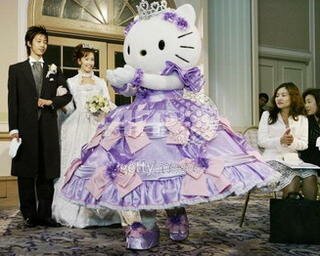
In a move that caused mass fainting fits across Japan (and audible gasps in neighbouring countries) the Hankyu-Daiichi hotel chain launched its Princess Kitty wedding package. For a pretty penny you can spend your wedding day immersed in Hello Kitty tweeness, from the ring pillow to the seating cards to the flowers. What better way to be the envy of your single friends by snaring a man and out Sanrio-ing them at the same time!
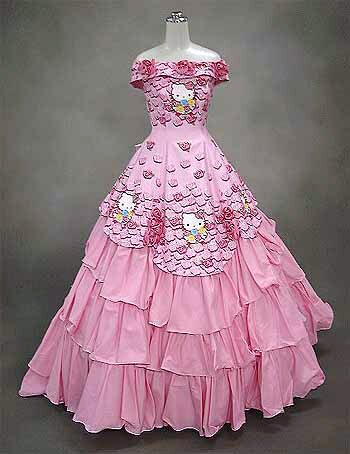
Worse follows, a line of Hello Kitty wedding gowns.:
AsiaPundit again notes that Kitty has been a cause of violence, riots and mayhem. I expect a higher-than-average percentage of Kitty-related weddings will result in divorce. And remember, cats are not monogamous. (h/t Simon)
Technorati Tags: asia, hello kitty, hong kong, japan, northeast asia
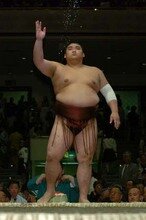
Via Boing Boing, the first professional Sumo-wrestling blogger to have come to my attention. The Japanese site is here and a translation of select posts here.:
Hi, this is me at the Kanazawa New Grand Hotel.
I arrived here to spend the night at 6:30 or so.
At a little after 7, my friend got here and after I finish some stuff up, we’ll be headed to get something to eat.
…various topics of conversation…
So I talked with my classmate about Athlete’s foot… His athlete’s foot.
It would seem that after his recovery, he relapsed. Take care man.
From tomorrow, it’s time for training!!! Yeah!!!
Oh yeah! You know “MEZAMASHI TV”?! Well, they are gonna broadcast about me and my blog on Tuesday, Oct. 25th at a little after 7:20.
I hope for your support in this as well. *bow*
…which means they are still gonna come take pictures, huh?
Ayn Rand’s Fountainhead is set to debut in China.
Ayn Rand’s more tolerable tome, The Fountainhead, hits Chinese bookstores in November. 700 pages, 800,000 characters, the story of Howard Roark’s individualist triumph over the forces of collectivism will arrive in cities whose architecture he would probably have had difficulty preventing himself from dynamiting.
Why is The Fountainhead getting translated? Numbers, for one thing. Most early reviews note Rand’s vast audience, with Atlas Shrugged selling second only to the Bible. It’s certainly not because of any literary value. The Beijing News, in a review casting it as a work of utopian fiction, calls it “long, dull, and unbalanced, with no sense of rhythm,” but says that as a work of philosophy, “we really shouldn’t use the standards of literature to evaluate it.”
Writing in The Economic Observer Review of Books, reviewer Shi Tao pinpoints why this book might appeal to today’s Chinese readers:
In Rand’s view, you need not abase yourself to pursue wealth, but you should be ashamed of yourself if you lack creativity. The IT elite who came along later highly praised this ideal.
Or it could just be that the “virtue of selfishness” is just the philosophy China’s rich need to explain away such unpleasantries as the wealth gap and social duties.
Via Boing Boing, Hu Yan has built a site featuring 500 photographs and commentary on Shanghai homes.:
Chen Mengjia (Shanghai, Corporate Chairman)
I have many hobbies and a rich life. I play golf, swim, go to concerts, have coffee and chat with my friends and go traveling. I dream to have a manor and a horse. I enjoy riding horses and having a carefree life. Human relations are too complicated in China and I’m stressed. It’s tiring to have your own company
Meng Rushun (Shanghainese, Retired Worker)

Zhu Fengying (Shanghainese, Retired Worker)

We hope our children be successful in their jobs and we can have a good health.
Technorati Tags: asia, china, northeast asia, shanghai, east asia
Via Boing Boing, a look at Malaysia’s heavy metal crackdown of the early 21st century:
It happened quite a while ago, in 2001. There was this big outcry over teenagers holding Satanic black metal concerts and stomping holy books and all that. Basically - imagine the whole Satanic Ritual Abuse hoo-ha with an added element of music.
I was in school during the time and there was an announcement made in morning assembly about it. According to the announcement, the crackdowns started after a imam (Muslim priest) walked into the woods and stumbled onto a black metal concert where holy books like the Quran and the Bible were set on fire and stomped on (and other such "Satanic" stuff).
The story (it’s never really been verified) got picked up by Harian Metro ("HM"), a Malay tabloid, and they really made a big deal out of it. The government then got involved. There were crackdowns in schools, kids were stripsearched in some places, and there were posters and information everywhere about supposedly Satanic symbols - including pentagrams and the hand signs for "I Love You" and "Rock On". Merchandise from bands like ACDC and Limp Bizkit were banned; so were their music, for a while. People who wore black T-shirts were looked at suspiciously - one local radio station had a problem with this because their T-Shirts were black!
Thankfully, due to the crisis, Malaysia developed an herbal treatment for heavy metal addiction, as noted in this 2001 BBC report (also via BB). I recommend it be developed for export and used on Gorogoth fans (they need some sort of treatment).
A state in Malaysia says it will give herbal medicine to 150 teenage rock fans accused of belonging to a Satanic cult.
Fadzil Hanafi, an official from the northern Kedah state told Reuters news agency: "This herb is to stimulate the brain so that students can concentrate on their studies."
Technorati Tags: asia, malaysia, music, southeast asia
Well known Hollywood stars have a secret they don’t want you to know about:
A Hollywood in-house secret, Japanese TV commercials were once talked about with a wink and a shake of the head. Piles of cash were paid to stars willing to peddle anything from whiskey to cigarettes, cars to coffee, instant noodles to cafe latte — as long as nobody told the fans back home. Hey, did you know Dennis Hopper did one for bath products? How much do you figure Leonardo DiCaprio got for that SUV spot? A million? Three?
However, these Hollywood stars are losing their popularity in Japan:
Sadly, the days of seeing, say, Harrison Ford guzzling Kirin beer may be over. American stars have not vanished from the Japanese advertising landscape, but their numbers have dropped dramatically since the heyday of the 1990s, when even Mickey Rourke was considered bankable here.
So who is taking the business from these Hollywood stars? Asian film stars are, led by the remarkable success of Korean film star Bae Yong-joon or otherwise known in Japan as Yon-soma:
“The Hollywood brand isn’t the best anymore, and Hollywood actors aren’t effective enough anymore,” said Yukio Mori, president of Systrat Corp., a marketing and promotion consultancy in Tokyo. “Consumers are in favor of singers or artists who are familiar, rather than foreign movie stars.”
The catalyst for the change, almost everyone agrees, has been Japan’s raging love affair with Korean culture that took everyone here by surprise two years ago.
The phenomenon was spearheaded by a drama series called “Winter Sonata,” a tragic love story featuring Bae Yong Joon, a South Korean actor affectionately referred to as Yon-sama in Japan. With his baby face and great teeth, Yon-sama, 33, flutters the hearts of Japanese women in their 30s and older, who tell market researchers he rekindles the romantic urges they felt in their youth.
It’s a demographic that makes marketers swoon, too. Yon-sama is now the biggest foreign star in Japan. Bigger than Brad. Bigger than Leo. Dozens of Japanese companies are desperate to attach their brand to Yon-sama, or at least to find the next great Korean star.
I don’t much care for Hollywood stars any more either, so I can’t blame the Japanese public getting turned off by them. Today’s Hollywood actors seem more concerned about promoting themselves and their politics than actually making good movies. Anyone see Sean Penn show up in a boat in New Orleans with his personal photographer?
Chinese film stars as well are having success advertising products in Japan including one of my personal favorites Zhang Ziyi:
And Asiance, a shampoo brand built on defining beauty with a pan-Asian look, has seen its market share grow after an ad campaign featuring China’s Zhang Ziyi, who starred in “Crouching Tiger, Hidden Dragon.”
If I was trapped in New Orleans I would rather have Zhang Ziyi come to save me instead of Sean Penn.
In a country filled with a thriving sex industry it comes as no surprise that Seoul now has it’s very own Erotic Art Museum:
Nestled behind the Hyundai Department Store next to Sinchon subway station, the Erotic Art Museum would be easy to miss save for a shiny golden replica of Michelangelo’s David outside that evokes both the elegance of some exhibits and the tawdriness of others.
The museum’s gregarious director, Won Myung-ku, did not stumble onto this calling by chance. A former worker in the tourist industry, he was blessed with the opportunity to do extensive traveling, during which time he came across and collected traditional craftworks dealing with sex from as far as Malaysia, Thailand and Africa. These experiences brought home to him how few such artifacts he had seen from his homeland.
“A culture of sex has been lacking in this country,’’ he said, “and I want to contribute to increasing the level of sex education among Koreans.’’
It is ironic that Mr. Won thinks Korea lacks a culture of sex when you are literally surrounded by the sex industry here. Just about every US military installation has clubs that offer prostitution right outside the main gates. Than there are multiple red light districts in every city here. I have even been on the remote Korean island of Ullong-do and I was amazed to see a red light district on the island as well. In addition to the clubs there are “barber shops”, massage parlors, and tea shops that offer their own sex services.
The museum does offer some interesting historical perspectives on Korean customs towards sex during earlier Korean dynasties:
Elsewhere, there is a wide array of phalluses, used for everything from preventing disease to promoting fertility to fighting infidelity. Apparently, in Choson times it was believed that if women in the village were committing adultery, it was a sure-fire sign of too much “umgi,’’ the feminine form of “ki,’’ or the “life-force’’ which is central to much Eastern philosophy and medicine. The placement of a large wooden phallus in the village was considered the best way to deal with this problem.
They may need to put theses phalluses on every street corner in Korea now a days.
Still more evil from the mouthless one from Sanrio.:
The Standard reports on the long arm of Sanrio and its damn cat:
Hello Kitty’s copyright holders are threatening to sue FM Theater Power, a local drama troupe, for infringing its intellectual property rights, it was revealed Thursday.
The stage enthusiasts, a group of secondary students and drama lovers, said they received a letter Wednesday last week from local solicitor Victor Chu and Co representing Sanrio of Japan accusing them of stepping on Hello Kitty’s copyright tail.
Sanrio requested that the drama group disclose all the details of activities connected with the production, promotion and staging of the play Kitty Hunter, including advertising materials, ticketing information, audience counts, revenue and profit…Banky Yeung, artistic director of the group and writer of Kitty Hunter, said the drama was simply a love story about a girl named Kitty, even though plush Hello Kitty toys are used as props and images similar to the cartoon character serve as promotion materials…
The good news for the theatre troup is this kind of publicity will do far more for ticket sales than any flyer.
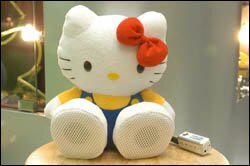
If you can stomach it, you can eat Hello Kitty.:
Technorati Tags: asia, hello kitty, japan
ESWN makes a good argument in defense of Yahoo!’s co-operation with Chinese state security, and says he expects stone silence to his post. Because of that, it gets top of the page in today’s roundup.:
The police came quickly, assessed the situation
and decided that there was a chance of a bomb. Hong Kong is one place that
takes possible explosives very seriously on account of the 1967
disturbances. All pedestrian and vehicular traffic along Nathan Road was
stopped, and all shoppers and workers were evacuated. This led to massive
traffic backups in one of the busiest part of the city. At around 930pm, the
explosive disposal squad was in place to defuse the bomb. A robot was sent
up and used a water gun to break open the box. Fortunately, there was no
bomb inside, just two bricks.
The investigators then looked at the piece of
cardboard. It read like a note from a disgruntled ex-employee of
PCCW. There was an email address: csl_no_pay_cash@yahoo.com.hk.
Based on this and other information (note: there was a web page URL that is
blurred out in the magazine photo), the man was arrested. He has been
tried and found guilty of threatening behavior. The judge said: "In
the 21st century of our times, there are numerious incidents of violence,
attacks and bombing in the world. To make the people of Hong Kong live in
a state of constant fear is a serious crime." The man has not yet
been sentenced. . .If several hundred requests come into Yahoo!
every day, how would they know which is which? As Jerry Yang said,
"We do not know why they want that information. We’re not told what
they look for." So in order to tell which is which, Yahoo! will have
an in-house Chief Privacy Officer, who will demand the law enforcement agency to
produce the full evidence, explain the purpose of the inquiry and then he/she
will play God/Supreme Court Justice and render a decision in his/her infinite
wisdom. Routinely, this CPO will have to make several hundred potentially
life-and-death decisions every day. Now who wants that Chief Privacy
Officer job, with all the pressures and the legal and moral liabilities?. . .
In the case of Shi Tao, the law enforcement
will simply say the subject is suspected of having sent a state secret document
overseas via the Yahoo! email account on a specific date. There is no
personal identification because the purpose of the request for the IP
information was precisely to detect the unknown subject. Would you think
that the CPO will then demand to read the state secret document before deciding?
Is the CPO a good judge? And does the CPO know how to deal with a genuine
national secret (such as the date and detailed plans of the invasion of Taiwan)?
I submit to you that Option 3 is not a good idea and corporate employees should
not be making these types of decisions.
As I said before, I expect stone silence to
this post, because the world is enjoying Yahoo!-bashing too much.
We now return to our regularly scheduled Yahoo! bashing.
Essential reading for cyber-dissidents, Reporters Without Borders has issued its guide for bloggers (pdf). Rebecca reviews it here.:
The Handbook for Bloggers is useful for beginners and veteran
bloggers alike. It starts out with several introductory chapters,
explaining how blogs differ from other kinds of websites, blogging
terminology, how to select a blogging tool and web-host, and how to get
started. The middle chapters focus on tips that even veteran bloggers
will find useful. Journalist, blogger and We the Media author Dan GillmorMark Glaser
offers tips on how to "make your blog shine." I learned a lot from the
chapter on how to get your blog picked up by search engines, written by
internet consultant Olivier Andrieu.
A while back, I posted an Atanu Dey item praising Singapore over India. Today, via Amit Varma, an item that argues Singapore’s northern neighbor also has some lessons for India.:
My wife and I are in Malaysia now on a short term assignment for our
company, and every time we step out of our house in Penang, we feel the
amazing effects of a liberal economic policy. This small, densely
populated island off the coast of Malaysia (Penang) is a big
electronics manufacturing base (thanks to a Free Trade Zone, and a port
that was formerly duty free) and it is easy to see what this has done
to the local economy.
There is a booming free-spending middle
class, and almost no poverty. Everyone who wants to work seems to be
able to find a job, and they are doing well enough to import labor from
Indonesia for low-paying jobs. There are signs of development
everywhere - new roads, new bridges, new high-rises. And from what I’ve
heard, Penang reflects what is going on around the rest of the country.Not
to say Malaysia doesn’t have its problems, but economically, they seem
to have found the secret to growth. We see all this, and naturally, the
next thing we think is, "When will this happen to India?"
We are
doing it backwards, it seems - Malaysia had manufacturing move over
here first, and that brought in a support engineering force which
slowly grew into a full fledged "high-tech economy." We got some
"low-tech" engineering activities first, and are hoping for the trickle
down from this to help our economy in other areas.
Far Outliers links to a study on the divergence of opinions in China and Canada on separatism.:
Whereas Canada has acclimatised to living next to its superpower
neighbour, absorbed the values of a virtual state and discarded the
traditional expectations of the importance of territory, China is a
rising power with an acute sense of grievance from the way it has been
treated historically, or at least the way it perceives it has been
treated. This strong inferiority complex has stimulated an intense
desire to do something about what many Chinese believe is their
misfortune, to occupy an international position that conforms to
traditional power politics and emphasises the value of territory.
Canada’s attitude is reinforced by its commitment to democracy and
interdependence, and to the granting of the wishes of the people of
Quebec, whatever they may be. The Chinese, on the contrary, lacking
both a commitment to democracy and self-determination or the status of
a developed state, view Taiwan not as an area containing a population
that should have some say in how they are governed, but as a
geopolitical object to be manipulated to maximise the glories of a
greater China.
Richard brings a troubling tale from the NY Times on police brutality and injustice in China.:
For three days and three nights, the police wrenched Qin Yanhong’s arms
high above his back, jammed his knees into a sharp metal frame, and
kicked his gut whenever he fell asleep. The pain was so intense that he
watched sweat pour off his face and form puddles on the floor.
On the fourth day, he broke down. "What color were her pants?" they
demanded. "Black," he gasped, and felt a whack on the back of his head.
"Red," he cried, and got another punch. "Blue," he ventured. The
beating stopped.
This is how Mr. Qin, a 35-year-old steel mill worker in Henan
Province in central China, recalled groping in the darkness of a
interrogation room to deduce the "correct" details of a rape and
murder, end his torture and give the police the confession they
required to close a nettlesome case.
On the strength of his coerced confession alone, prosecutors
indicted Mr. Qin. A panel of judges then convicted him and sentenced
him to death. He is alive today only because of a rare twist
of fate that proved his innocence and forced the authorities to let him
go, though not before a final push to have him executed anyway.
In light of the bird flu scare in neighboring Indonesia (which authorities there are calling an epidemic) Malaysia is cracking down on chicken smugglers (surely there are more lucrative illegal trades).:
I mean real chickens, the ones we have on our table for dinner. Yes,
it seems Malaysia actually has a shortage of chickens, hence a window
of opportunity opens itself for more dubious characters to actually
make a living smuggling them from neighbouring countries.
Now I know why a friend of mine who was an accountant quit his job
to open a chicken farm. The ‘rumour’ that McDonalds Malaysia created
quite a few ‘chicken’ millionaires might be true then.
From a Reuters report,Malaysia said on Wednesday it was boosting precautions
against bird flu, and considering fines or jail terms for smugglers of
poultry from neighbours such as Indonesia, now battling the disease.
Seven-years to the day following his jailing, as Lone notes, former Malaysian PM Anwar Ibrahim announced he plans to sue former Prime Minister Mahathir Mohamad for defamation.:
Former Malaysian deputy premier Anwar Ibrahim said Tuesday he will
launch a lawsuit against one-time prime minister Mahathir Mohamad for
accusing him of being a homosexual.
Mahathir said earlier this
month that he was forced to sack Anwar in 1998 to prevent mainly-Muslim
Malaysia from having a homosexual leader. Anwar was jailed for sodomy
after his sacking but the conviction was overturned last year.
"I
cannot have a person who is like that in my cabinet who may succeed and
become the prime minister. Imagine having a gay prime minister. Nobody
would be safe," Mahathir told reporters.
Anwar said he was
"shocked" to hear of Mahathir’s "defamatory" remarks, particularly
after a court last month awarded him 1.2 million dollars in damages
over a book that aired the sodomy allegations.
"I will not
allow this lie and slander to continue. Thus I have instructed my
counsel to initiative legal action against Tun (honorific) Mahathir,"
he said in a statement.
Lucia Lai notes that some concerns are being voiced over Dr M being allowed to participate in a human rights conference.:
The Human Rights Commission of Malaysia (Suhakam) marked its 6th
anniversary and Human Rights Day in Malaysia recently by holding a
hypocrisy party in the capital city, with former premier Dr Mahathir
Mohamad giving the opening address.
A group of 30
non-governmental organisations (NGOs) had initially written an open
letter to Suhakam urging it to "close the door" on Dr M for a simple
reason that he had committed a host of "human wrongs" with regard to
human rights at home.
They had provided Suhakam a list of human
rights abuses in Bolehland by Dr M and pointed out that it would be
wrong to invite "a leader who perpetrated extensive human rights
violations" during his 22-year political reign."
AsiaPundit has earlier noted South Korean concerns about how Google Earth allows users to view the South Korean presidential compound and military bases, Pyong’yang, and the secretive Communist Party of China compound of Zhongnanhai. Politics 101 Malaysia is now noting that the spy satellite for the masses is causing concern in Kuala Lumpur.:
After recent my recent comments on Google Earth here and here, the fear continues.
A United Press International report on
Tuesday says terrorists and “rogue state†intelligence agencies could
be making use of free internet satellite images that leave sensitive
British military facilities exposed.
Yet again I ask, will our parliament address this issue during this session?
As far as video games go, the 2005 Tokyo Game Show
was something of a let down. Microsoft to its credit had the Xbox 360
up and running, yet the playable games on offer hardly sent the pulse
racing. Sony on the other hand managed to do nothing but frustrate,
showing only videos of future PlayStation 3 software, the majority of
which contained very little (if any) in-game footage.Thankfully
the ubiquitous booth babes saved the day, the scantily clad young
ladies more than making up for the lack of quality games on offer….
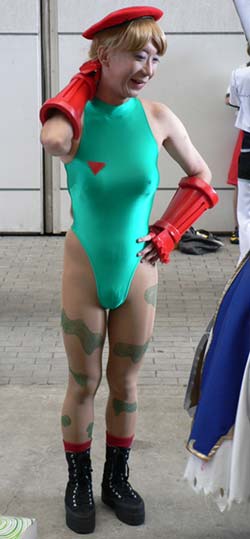
Yet amazingly, this bevy of beauties was upstaged by the event’s
massive cosplay contingent. ..
However despite the coy smiles and tasteful wigs, I think it was the
shapely legs and green leotard of the group’s feminine leader that
grabbed most people’s attention.
A Taiwanese in China creates a blog dedicated almost entirely to toilets (seriously).:
This one is the same as last one. Toilet in tibet temple. These walls
are higher than those in 1st picture. So, you can not play cards with
your friends who go to toilet next to you. :)…This toilet is more "modern". This one was taken in
a famous tibet temple in yovnan. The small metal spot on the wall is
the button for you to clean your "waste".
Do
you know how to go? Yes, face out. No door, of course. But, in this
toilet, there is water. You can push the button on the wall. Yes, that
very small metal spot in the picture. So, in this kind of toilet, no
shit smell. It’s clearier. There is also another kind of toilet in the
very courtryside place. I did not take pictures. CAUSE, I CAN NOT GO
INTO THAT KIND OF TOILET. Shit everwhere near the door of that kind
toilet. How can I go? It’s really very strange. How do local people go?…

Usually,
this kind of very local & old toilet are in very small viliages.
"public toilet", mm, maybe. So, next time when you have a chance to
drive along a road in small countries in mainland China, remember to
find "public toilet". Then you can see this very localized toilet in
person.
Monty Python needs to reform and do a skit on Taiwan politics, like the WUFI, the People’s Front of Judea are also Splitters/Splittists.:
In case you were wondering the ‘World United Formosans for Independence’ and the ‘Taiwan Defence Alliance’ should not be confused with pro-formal independence political parties like the Taiwan Solidarity Union (which regularly polls between 5-10% in national elections), the ‘Taiwan Independence Party’ (which gained 0.3% of the vote in the last election), the ‘Peasant Party’ (0.4%) or the ‘Taiwan Number One Party’ (didn’t bother standing).
Someone will not be getting another invite to speak at Beijing University.:
Prominent Taiwanese commentator/legislator/raconteur Li Ao delivered one mother of a speech
at Beijing University yesterday. In front of a stunned audience, with
several high-ranking mainland government officials openly squirming on
stage, Li let her rip.
He openly criticized China’s censorship, saying that went against
what even Mao Zedong and Zhou Enlai would have wanted. Quoting the
Collected Writings of Mao Zedong, he said,
"凡是æ·å²ä¸Šç™¼ç”Ÿçš„æ±è¥¿ï¼Œéƒ½è¦åœ¨æ·å²ä¸Šæ¶ˆæ»…ã€‚å› æ¤ï¼Œå…±ç”¢é»¨ç¸½æœ‰ä¸€å¤©è¦æ¶ˆæ»……,S’s" i.e. "Every
historical figure that has risen has also been destroyed. One day the
Chinese Communist Party will also be destroyed by history…our mission
is to bring about its destruction a little more quickly." He made
not-so-subtle references to the Tiananmen massacre, saying that all
governments are bastards who are willing to open fire on their own
people. He even got in plenty of digs against the
charismatically-challenged former KMT chairman Lian Zhan and the
charismatically-gifted but politcally-challenged current KMT chairman
Ma Yingjiu.
Mr Wang notes Jacob’s run in with the authorities because his number was saved on Singapore Rebel director Martyn See’s cellphone. Mr Wang says the Singapore police really should exercise some restraint, at least for PR reasons.
…please bear in mind that Martyn See is blogging about every stage of
your investigations. This is a highly sensitive case. All kinds of
media organisations, international and local, are closely following
Martyn See’s blog for updates. So Mr Wang advises you to take extra
care in how you conduct your investigations. If you do any silly things
like Haul Anyone and Everyone Who Is Found in Martyn See’s Handphone
Down to the Police Station For Interviews, Martyn will blog about it
and the whole world will read his blog and think the Singapore police
is really acting silly.
Japundit reminds us why Engrish.com should be a regular surf stop.: